

Choosing Between Isuzu And FUSO Trucks: The Ultimate Guide

Choosing between the expansive Isuzu vs. FUSO lineups for your upcoming business venture? The decision is becoming more and more one-sided. While FUSO trucks are well-known for their durability and versatility, Mitsubishi FUSO no longer sells new models to American drivers. That means you'll be working with a 2021 FE180 as your most modern edition, while the N-Series and F-Series gas and diesel haulers you'll find at Nimnicht Isuzu Trucks continue to evolve, improving their fuel efficiency, towing capacity, and maintenance benefits as the years go on.
Isuzu vs. FUSO Differences Summary
- FUSO trucks were discontinued in 2021 in the U.S., leaving half-decade-old powertrains as the least worn offerings.
- Isuzu gas haulers have design lives of 200,000 miles, while diesel powertrains get 375,000 miles or more when properly maintained. FUSO options that can match that potency are likely already approaching it.
- While FUSO Class 4 gas vehicles offer excellent payload ratings, the Isuzu brand provides a much wider variety of categories for you to select.
- Mitsubishi FUSO models will likely only be supported for a few more years, while the network of Isuzu programs continues to adapt to customers.
- FUSO interiors were quite impressive for 2021, but by 2025, you can trust the Isuzu brand to have state-of-the-art safety and convenience for your drivers.
Isuzu vs. FUSO Truck Lineup Overview Chart
| Features | Isuzu Trucks | Fuso Trucks |
|---|---|---|
| Reliability | Consistently high, with a B10 rating of 375,000 miles for diesel | Lowered; FUSO support in America drying up |
| Fuel Efficiency | New model years offer better estimations | Older engines show wear and tear |
| Lineup | Adding new N-Series and F-Series models yearly | No longer adding additional models |
| Payload Capacity | Higher among Class 5 options | Higher among Class 4 options |
| Service Locations | Over 300 nationwide | Less than 200 nationwide |
| Comfort | Tailored seats, add-on support like suspension seat | Details unavailable |
| Technology | Available touchscreen audio, keyless entry, and Mobileye | Bluetooth® radio, keyless entry, Mobileye |
| Resale Value | Higher | Lower |
| Cost of Ownership | Kept low thanks to available Priority Service Maintenance Program | Maintenance programs likely to end |
| Warranty Coverage |
|
|
As the earliest available Class 4 trucks, the Isuzu NPR Heavy Duty and FUSO FE140 are the most competitive options to put side-by-side. The 297-horsepower FUSO 6-liter V-8 engine gets outperformed readily by the 6.6-liter powertrain of the Isuzu NPR-HD, sporting 350 horsepower and 425 pound-feet of torque. The Isuzu NPR-HD ends up with a higher payload with some configurations and also has smoother acceleration thanks to a more potent eight-speed automatic transmission.
| Specifications | Isuzu NPR-HD | Fuso FE140 |
|---|---|---|
| Category | Class 4 | Class 4 |
| Engine | 6.6L 8-cyl | 6L V-8 |
| Horsepower | 350 | 297 |
| Torque | 425 lb-ft | 361 lb-ft |
| Transmission | 8-speed auto | 6-speed auto |
| Payload Limit | 8,277 - 8,986 lbs2 | 8,800 lbs2 |
| GCWR | 20,500 lbs3 | 22,215 lbs3 |
| GVWR | 14,500 lbs4 | 14,500 lbs4 |
The only real advantage of the FE140 is a slight increase in GCWR, which gives it a slight edge in towing capacity. However, as we'll soon see, there are many better options available for you regarding larger trailers and bigger hauls.
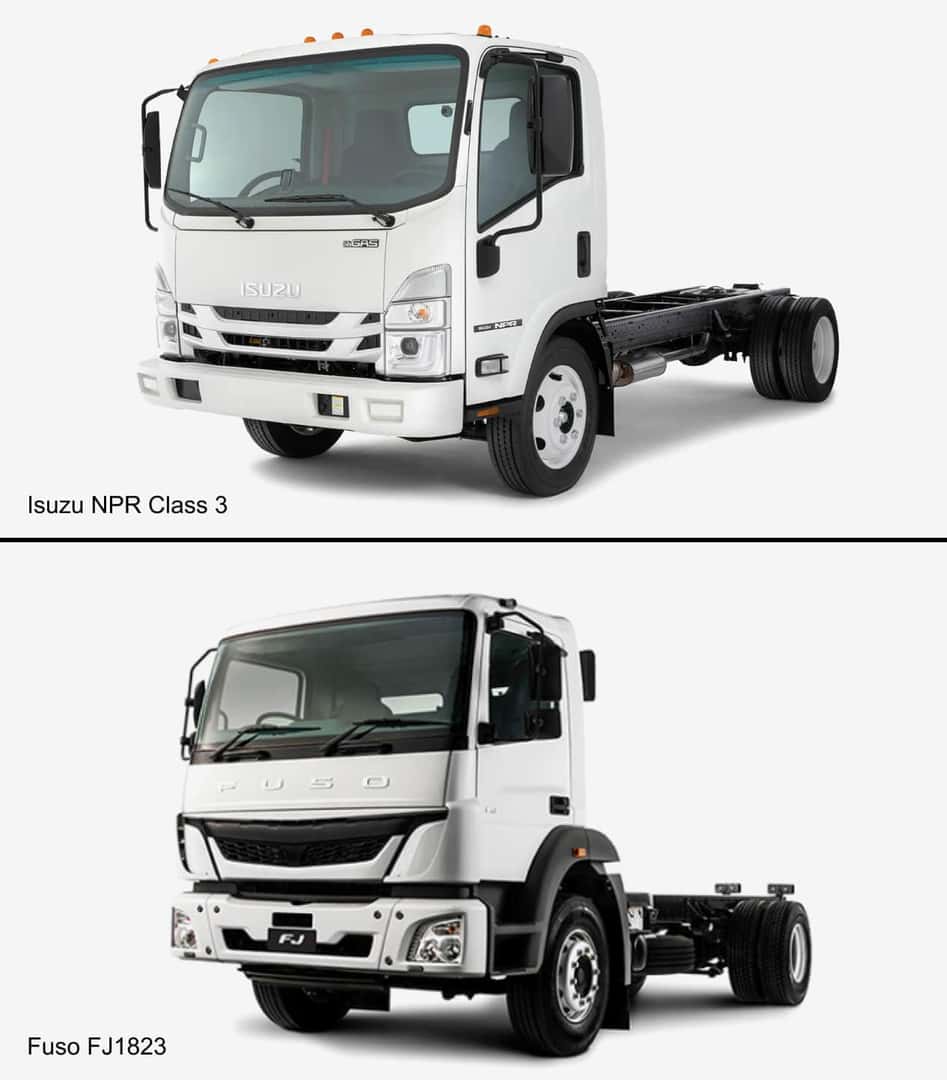
FUSO vs. Isuzu Trucks: Models & Configurations
While the American FUSO lineup was discontinued in 2021, the Isuzu model lineup continues to evolve and improve to this day. If you want a FUSO truck from 2019, 2020, or 2021, you have three gas-only options:
- FE140 (Class 4)
- FE160 (Class 4)
- FE180 (Class 5)
If you open up to 2017 models – which are nearly 10 years old by now – you can have up to eight diesel and gas options that range from Class 3 to 5.
If you instead shop at our Isuzu dealership, selection is the name of the game. Not including wheelbase and cab size, you can get up to nine variants, with certain editions able to be configured as a diesel model:
- NPR (Class 3, Gas)
- NPR-HD (Class 4, Gas and Diesel)
- NPR-XD (Class 4, Diesel)
- NQR (Class 5, Gas)
- NRR Derate (Class 5, Diesel)
- NRR (Class 5, Gas and Diesel)
- FTR (Class 6, Diesel)
- FVR Derate (Class 6, Diesel)
- FVR (Class 7, Diesel)

Isuzu vs. FUSO Lineups: Payload Explored
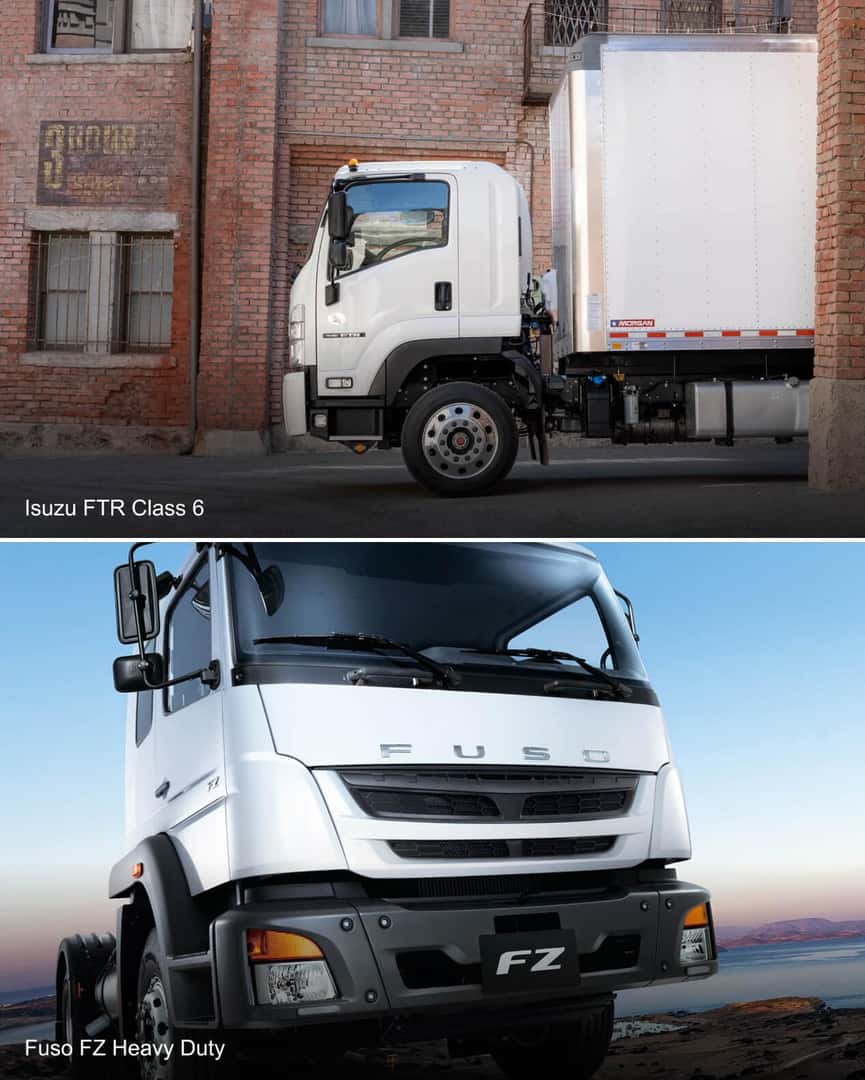
This discrepancy in choices leads to a mismatch between the two models in terms of payload. The Class 4 selection has the most competitive array. FUSO Class 4 models have payload capacities between 8,800 and 10,295 pounds2 while Isuzu offerings get to 9,576 pounds with the NPR-XD.2
However, due to the discontinuation of the FUSO brand in America, this is essentially all you receive. Outside of the Class 5 FE180 at 11,855 pounds of payload limit,2 the FUSO lineup of 2020 and 2021 can't offer anything else for drivers. Meanwhile, Isuzu continues to have an up-to-date inventory, providing the maneuverable full-size Class 3 NPR with as low as 6,115 pounds of payload capacity2 or the Class 7 FVR, with a titanic optional 22,989-pound limit2 – nearly double the most modern FUSO FE180. The 2017 FE180 Diesel can try to keep up with its capacity of 12,490 pounds,2 but the maximum possible potency is clearly with the Isuzu brand.
Isuzu vs. FUSO Full-Size Truck Reliability
We finish our comparison between these two automakers by considering how reliable they are. If FUSO were still supporting American manufacturing, the competition would be quite close. Both FUSO and Isuzu trucks utilize similar engine structures, meaning that, according to Isuzu brochures, modern vehicles would be designed for 200,000 miles with gas engines and beyond 375,000 miles for diesel ones. These companies offer a three-year/36,000-mile Basic Warranty1 and a five-year Frame Coverage.1
According to representatives, FUSO vehicles will no longer be directly supported after 2028, when warranties and leases for their new selection expire. After that point, we expect the under 200 Mitsubishi FUSO dealerships to reorient themselves around a new brand, like Isuzu or Hino inventories, or become used lots. Looking ahead, you may not be able to get an extended warranty or up-to-date service for the aging FUSO brand.
Meanwhile, Isuzu customers gain access to a wide variety of services for managing and maintaining their fleet at over 300 locations nationwide. For instance, all Isuzu trucks for sale usually come with the opportunity to sign up for the Priority Service Maintenance Program when you purchase or lease one. This multifaceted approach to customer service is available for diesel engines under 35,000 miles or gas powertrains under 25,000 miles. It allows you to prepay for services like additional brake replacements, tire replacements, or DPF. Enjoy exceptional value at routine maintenance schedules with a deal that's guaranteed to last far beyond 2028.
Treat Yourself to Modern Efficiency at Nimnicht Isuzu Trucks
That concludes our look at Isuzu trucks vs. FUSO trucks. FUSO haulers have a legacy of quality experiences and design, but with the company pulling out of the United States four years ago, their workhorses are starting to show their age. That's why our Isuzu inventory is the clear choice for business owners. From more up-to-date transmission and engine selections, a wider array of vehicle categories, and guaranteed support for years to come, the Isuzu N-Series and F-Series are ready to join your committed fleet or growing business.
Frequently Asked Questions
Do Isuzu trucks handle heavy payloads better than FUSO trucks?
While Isuzu and FUSO trucks of Class 4 carry about the same as one another, FUSO haulers of Class 5 tend to have lower payload capacity than the Isuzu options. For example, the Isuzu NRR can carry upward of 13,611 pounds, and the FUSO FE180 is only rated to haul 11,855 pounds.2 Unlike your FUSO choices, the modern Isuzu lineup also includes Class 6 and 7 models.
Which is better for urban delivery: Isuzu or FUSO trucks?
Isuzu trucks offer a higher level of upfitting and more options for urban work than FUSO. Currently, the most modern FUSO offerings are only in Class 4 and 5 categories, with a 2017 Class 3 on the used market. The NPR is an up-to-date Class 3 choice from the Isuzu brand, with a GVWR of 12,000 pounds,4 which makes it easier to maneuver in streets.
Can I upfit a FUSO truck as easily as an Isuzu truck?
While there are services that allow you to upfit a FUSO truck, those programs are likely to stall when Mitsubishi Motors officially pulls their commercial line out of America. Isuzu vehicles aren't only easy to upfit, but you can get guidance, parts, and customization work done at over 300 dealerships nationwide – compared to the fewer than 200 FUSO locations.
Featured Reviews For Isuzu Vs. Fuso Trucks:
Contact us to learn more about Isuzu trucks!
1Warranties listed on this web page shall not be solely relied upon. Warranties may be subject to specific terms, restrictions, exclusions, and fees. Additional warranty information may be obtained by visiting the official website of the warranty provider. Contact our dealership for complete details.
2Max payload varies based on accessories and vehicle configuration.
3GCWR ratings assume vehicles are properly equipped with manufacturer-recommended towing setups. Actual weight capacities may vary.
4GVWR ratings assume vehicles are properly equipped with manufacturer-recommended towing setups. Actual weight capacities may vary.
Search By Keyword
Search By Filters
Choose How To Share:
904-712-4982
Call Now11491 Philips Hwy • Jacksonville, FL 32256
Get DirectionsToday's Hours:
Open Today! Sales: 8am-5pm
Open Today! Service: 7:30am-5pm